Most homeowners should clean and inspect gutters at least twice a year—typically in spring and early fall—and more often when mature trees shed leaves or storms bring heavy debris. But the calendar is only a starting point. A gutter system can look clean and still send water toward the foundation through a blocked underground line, a short extension, poor grading, or an eroded discharge area.
The useful question is not simply “Are the gutters empty?” It is: Where does roof water go during and after a normal rain? A working system carries water from the roof, through the gutter and downspout, and far enough away that it does not pool beside the house.
A practical gutter-cleaning schedule
| Home condition | Starting schedule | Inspect sooner when... |
|---|---|---|
| Few nearby trees and moderate weather | Twice a year | You see overflow, staining, or pooling |
| Large trees near the roof | Several checks during leaf and seed drop | Leaves collect in valleys, screens, or downspout inlets |
| Frequent severe storms | After major storms plus seasonal cleaning | Branches, shingle granules, or storm debris enter the gutters |
| Gutter guards or screens | Inspect at least twice a year | The guard surface is covered or water spills over it |
Twice-yearly cleaning is a practical starting point for many homes, but it is not a guarantee that the system will remain clear between visits. Nearby trees and storm exposure may require more frequent checks.
Add a quick visual check after a major storm and during the first substantial rain after cleaning. Do not wait for the next scheduled cleaning if you notice water spilling over the edge.
Inspect the whole drainage path, not just the gutter
A gutter system has several failure points:
- Roof edge: Water may bypass the gutter if flashing is loose, the roof edge is misaligned, or the gutter is undersized.
- Gutter channel: Leaves, needles, mud, and roof granules can block flow or add enough weight to make the gutter sag.
- Outlet and elbows: A downspout can be blocked at the gutter opening, at a bend, or where sections join.
- Bottom discharge: A short, crushed, disconnected, or poorly aimed extension can release water beside the foundation.
- Underground drain: A buried line can be clogged or disconnected even when the visible downspout appears clear.
EPA moisture-control guidance emphasizes keeping roof water away from the foundation, while local drainage guidance recommends checking both the gutter condition and the area where water is discharged.[2] [3]
Visual warning signs: what the problem probably means
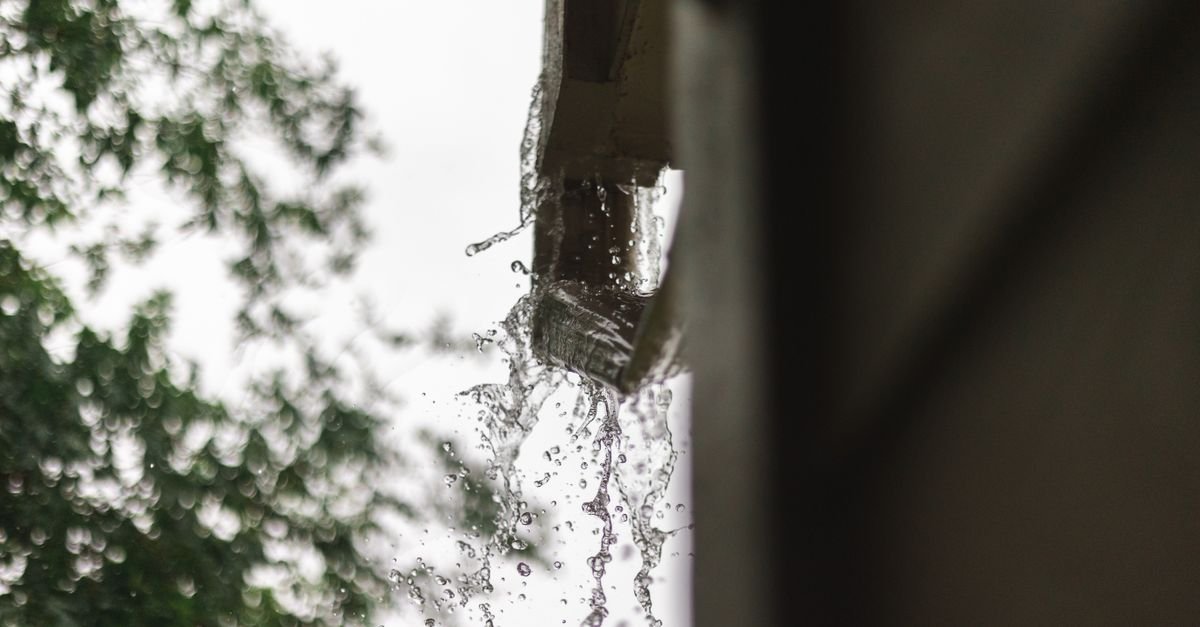
Visual warning sign 1: Water pouring over the front of the gutter
Likely causes: debris, a blocked outlet, a sagging section, an incorrect gutter pitch, or a system that cannot handle the roof runoff during heavier rain.
First, check whether debris is visible. Then look for a low spot along the gutter line. If the gutter is clean and still spills during ordinary rain, the problem may be capacity, pitch, roof drainage concentration, or a blocked outlet rather than a simple cleaning issue.
Visual warning sign 2: A clean gutter with a muddy splash mark below it
Likely causes: water is escaping at a seam, the downspout connection, or the roof edge. A clean channel does not rule out leakage. Look for dark streaks, damp fascia, peeling paint, or repeated erosion below one joint.
Visual warning sign 3: A gutter line dipping between hangers
Likely causes: loose or failed hangers, excess debris weight, or damaged fascia. Sagging creates a low point where water and sediment collect, so cleaning alone may provide only temporary relief.
Visual warning sign 4: Water pooling beside the house after the downspout runs
Likely causes: a short extension, a collapsed or blocked underground pipe, compacted soil, or grading that slopes toward the house. A downspout should not simply empty at the base of the wall.
As a general performance target, EPA Indoor airPLUS requirements direct roof water at least 5 feet from the foundation when it discharges onto sloping grade, or into an appropriate underground system that discharges farther away. Local site conditions and rules may differ, especially for connected stormwater systems.[4]
A safe inspection routine
From the ground, inspect gutters and downspouts during daylight for overflow marks, rust, loose sections, sagging, separated joints, and damaged extensions. Use binoculars or take photos from the ground if the roof edge is difficult to see.
If ladder access is necessary, use a stable ladder on level footing, maintain three points of contact, face the ladder, and avoid overreaching. OSHA advises against standing on the top step or using a damaged ladder.[7] Do not climb onto a steep, wet, fragile, or high roof to clean gutters. Hire a qualified professional when the work requires roof access, a long extension ladder, difficult terrain, or handling near overhead wires.
How to test a downspout without guessing
- Choose a dry day after removing visible debris from the gutter and downspout opening.
- Place a hose into the gutter near the downspout outlet, using a moderate flow.
- Watch the entire route: the gutter, downspout joints, elbow, extension, and discharge area.
- Confirm that water exits freely and does not back up, leak from seams, or pool against the house.
- If the downspout disappears underground, look for a clean discharge point. If none is visible, do not assume the buried line is working.
Stop if water begins backing up toward the roofline or if the test could send water into a wall, crawl space, basement window well, or electrical equipment. A buried drainage problem may require a drainage contractor or plumber to locate and clear it.
Better downspout-discharge options
The best outlet depends on the slope, soil, roof area, and local drainage rules. Common options include:
- Flexible or rigid extensions: Useful when the outlet can discharge onto stable, sloping ground away from the home.
- Splash blocks: Helpful for spreading flow and reducing soil erosion, but they are ineffective if they direct water back toward the foundation.
- Rock or planted drainage areas: Can slow and spread runoff when properly placed and sized for the site.
- Rain barrels: Can capture roof runoff for later landscape use, but they need a screened inlet, an overflow route, and regular emptying. Pennsylvania State University Extension notes that slowing gutter runoff can reduce soil erosion around a home’s foundation.[5]
- Underground drainage: May be appropriate where surface discharge is impractical, but it should have a known outlet and should not be connected casually to a foundation drain or other system.
Do not redirect water onto a neighbor’s property, toward a walkway, against a retaining wall, or onto a slope where it could create erosion. Some communities regulate connections to storm drains or require specific drainage designs, so check local requirements before changing a buried system.[6]
For a broader seasonal checklist, add this gutter-and-downspout inspection to the annual home inspection homeowners can do themselves. You can also use a home maintenance schedule to record the cleaning date, storm observations, and any repairs.
The bottom line
Clean gutters at least twice a year, then adjust the schedule for trees, storms, and visible debris. After cleaning, test where the water goes. Overflow, sagging, muddy splash marks, and foundation-adjacent pooling are more useful warning signs than the calendar alone. A gutter system is doing its job only when roof water leaves the property’s vulnerable areas in a controlled way.
Five-minute drainage check
- Look for overflow marks or erosion below every gutter run.
- Check that each downspout is connected and supported.
- Confirm that extensions point away from the house.
- Watch a hose test for free flow and leaks.
- After rain, photograph any pooling so you can compare the same area over time.
Sources
- Gutter Safety — West Virginia University Extension
- Moisture Control Guidance for Building Design, Construction and Maintenance — U.S. Environmental Protection Agency
- Gutters and Downspouts: Wetness or Erosion Problems — Northern Virginia Soil and Water Conservation District
- Indoor airPLUS Verification Requirements, Version 2 — U.S. Environmental Protection Agency
- Rain Barrels: Information and Guide — Pennsylvania State University Extension
- Soak Up the Rain: Disconnect / Redirect Downspouts — U.S. Environmental Protection Agency
- Portable Ladder Safety QuickCard — Occupational Safety and Health Administration